The Anxiety Insomnia Loop: How to Break the Cycle When Sleep and Worry Feed Each Other
It's 2 AM. You've been awake for an hour. The anxiety started the moment your head hit the pillow, and now you're watching the clock, calculating how many hours of sleep you'll get if you fall asleep right now. Which, of course, makes sleep less likely.
The anxiety insomnia loop is bidirectional. Anxiety disrupts sleep. Poor sleep intensifies anxiety. Each night reinforces the pattern until your bed starts to feel like the most anxiety-producing place in your house.
Here's how the loop works at the nervous system level and a bedtime protocol designed to interrupt the cycle.
How the Loop Runs
The anxiety insomnia loop has two engines running simultaneously:
Engine one: anxiety disrupts sleep
When your nervous system is activated, the body is in a mobilized state. Heart rate stays elevated, cortisol stays high, and the muscles stay braced. Sleep requires the opposite: parasympathetic dominance, heart rate deceleration, muscle release.
Anxiety at bedtime is the nervous system refusing to shift into sleep mode because the threat detection system is still running. Your body won't sleep while the body thinks something dangerous is happening.
Engine two: poor sleep amplifies anxiety
Sleep deprivation reduces the prefrontal cortex's ability to regulate emotional responses. Research shows one night of poor sleep increases amygdala reactivity by up to 60%. The brain's alarm system becomes more sensitive on less sleep, which means more anxiety the following day, which means more sleep disruption the following night.
The two engines feed each other. After a few cycles, the pattern becomes self-sustaining.
Why Nighttime Makes Anxiety Worse
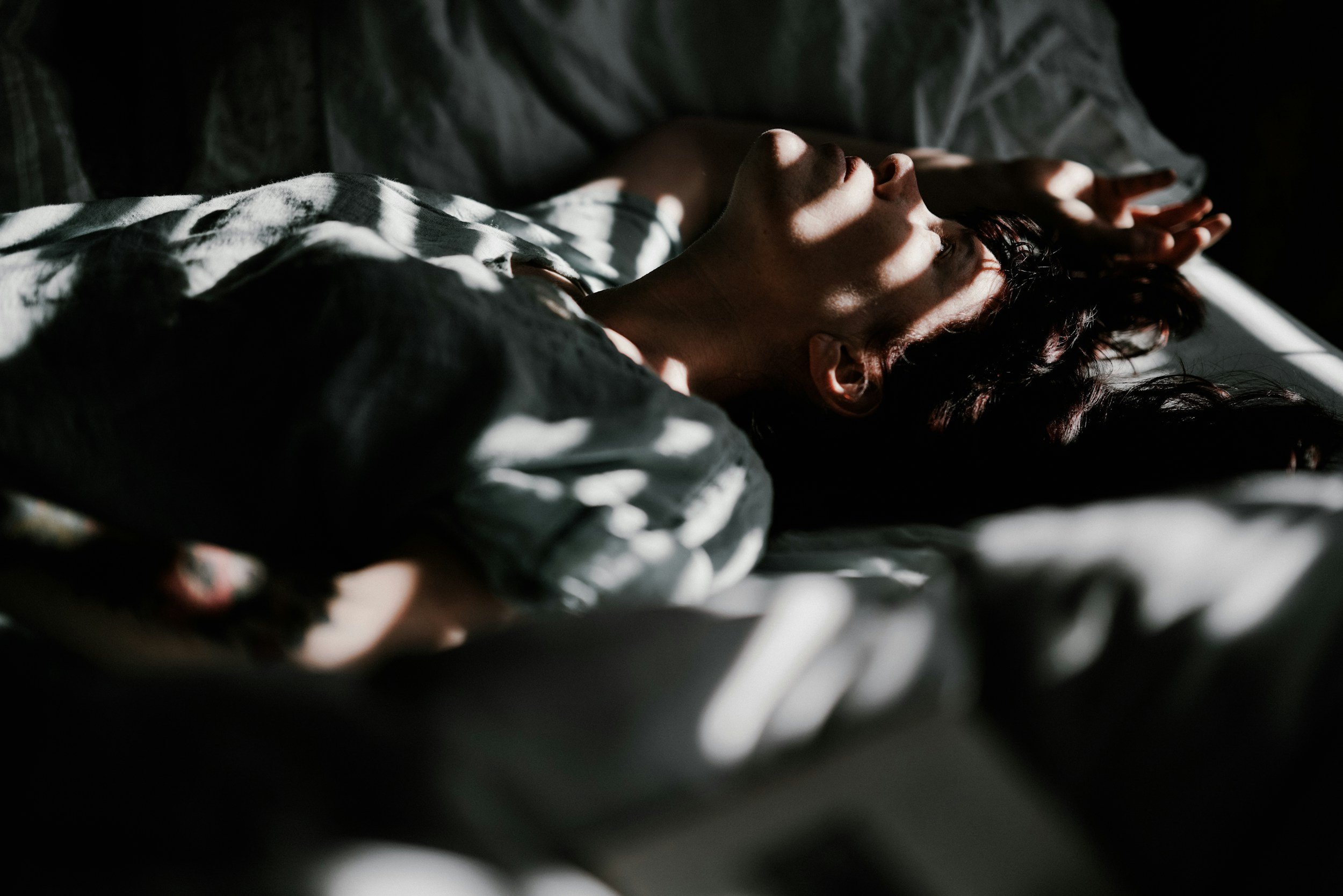
Several factors converge at bedtime:
Loss of distraction
During the day, work, conversations, screens, and tasks keep the mind occupied. At night, the distractions stop. The anxious thoughts that were running in the background all day now have the stage to themselves.
Cortisol timing
Cortisol (your stress hormone) naturally dips in the evening. If your nervous system is dysregulated, the cortisol curve flattens or inverts: levels stay elevated at night instead of dropping. Your body is chemically primed for alertness when the environment is asking for sleep.
The bed becomes a trigger
After enough nights of lying awake with racing thoughts, the bed itself becomes associated with anxiety instead of rest. Your nervous system now reads "getting into bed" as a cue to activate. The mattress becomes a threat stimulus.
Darkness removes visual safety cues
Your nervous system uses visual input to assess safety. Darkness removes the input. For some people, the reduced visual information increases the threat detection system's sensitivity, making the body more vigilant, not less.
The Bedtime Protocol: Breaking the Loop
This protocol targets the nervous system, not the thoughts. Trying to stop thinking at 2 AM is like trying to stop a car by talking to the engine. You work with the body first.
Step 1: Create a wind-down buffer (60 minutes before bed)
Reduce light exposure (dim overhead lights, use warm-toned lamps)
Stop screen use or switch to a non-stimulating activity (reading, gentle stretching)
Avoid news, email, and social media during this window
Lower the room temperature (cool environments signal the body to prepare for sleep)
The buffer tells the nervous system the environment is shifting toward rest. Jumping from high-stimulation activity directly into bed asks the nervous system to make a transition without a bridge.
Step 2: Nervous system reset (15 minutes before bed)
Choose one:
4-7-8 breathing (inhale 4, hold 7, exhale 8) for 4-8 cycles. This technique produces the strongest parasympathetic shift of any standard breathing exercise.
Body scan: start at the feet and slowly move attention upward, noticing each body part without trying to change anything. The attention itself shifts the nervous system from "doing" mode to "being" mode.
Gentle self-touch: place one hand on your chest and one on your belly. The warmth and pressure activate the body's self-soothing system.
Step 3: If you're not asleep in 20 minutes, get up
This is the most important step. Lying in bed awake reinforces the association between bed and anxiety. If 20 minutes pass without sleep:
Get out of bed
Go to a different room or a different spot
Do something low-stimulation: read a physical book, listen to calm audio, do a puzzle
Return to bed when you feel drowsy
Repeat as needed. The goal is retraining the nervous system to associate bed with sleep, not with anxious wakefulness.
Step 4: Morning regulation resets the cycle
What you do the next morning matters as much as what you do at night:
Wake at the same time every day, regardless of how much you slept
Get natural light exposure within 30 minutes of waking (this resets the cortisol curve)
Avoid caffeine for 90 minutes after waking (caffeine too early disrupts the natural cortisol peak)
Move your body: a 10-minute walk is enough to signal the nervous system that the day's activation is starting on purpose, not by accident
Step 5: Track the pattern, not the hours
Stop counting hours of sleep. Tracking sleep quantity feeds the anxiety. Instead, track:
What time you started your wind-down buffer
Which regulation technique you used
Whether you got out of bed after 20 minutes of wakefulness
How you felt in the morning (not how many hours you logged)
This shifts focus from the outcome (sleep) to the process (nervous system regulation), which is the part you control.
When the Loop Needs Professional Support
If the protocol helps but the pattern persists, or if the anxiety insomnia loop has been running for months, professional support addresses the nervous system patterns driving the cycle.
Therapy for the anxiety insomnia loop targets:
The nervous system activation pattern keeping the body in alert mode at night
The conditioned association between bed and anxiety
The underlying daytime anxiety feeding the nighttime symptoms
Co-regulation with a therapist to help the nervous system learn to settle
If you want a starting point before or alongside therapy, the Welcome Home mini-course walks through nervous system basics at your own pace for $9. The free Nervous System Reset guide is also available if you want something to work with today.
Inner Heart Therapy uses a nervous system approach to anxiety and sleep issues. Telehealth sessions are available across Idaho, Utah, Colorado, Connecticut, Delaware, South Carolina, and Florida.
Schedule a free consultation to talk about what the loop looks like for you and what would help.
FAQ
Why does anxiety get worse at night?
At night, distractions stop, cortisol timing shifts, and the nervous system loses visual safety cues. The anxious thoughts running in the background all day now have uninterrupted access. After repeated nights of anxious wakefulness, the bed itself becomes a trigger for activation.
How do I break the anxiety insomnia cycle?
Use a structured bedtime protocol: 60-minute wind-down buffer, nervous system reset breathing (4-7-8 breathing), get out of bed after 20 minutes of wakefulness, maintain a consistent wake time, and get morning light exposure. Target the nervous system, not the thoughts.
Is anxiety insomnia a real condition?
Anxiety-related insomnia is a well-documented pattern where anxiety and sleep disruption reinforce each other. The bidirectional relationship between anxiety and sleep is supported by extensive research showing that poor sleep increases amygdala reactivity, which amplifies anxiety.
Should I take sleep medication for anxiety insomnia?
Medication is a question for your doctor, not a blog post. What this post addresses is the nervous system component of the loop. Many people find nervous system regulation, behavioral changes (the 20-minute rule, consistent wake times), and therapy resolve the pattern without long-term medication.
How long does the anxiety insomnia loop take to break?
With consistent use of the bedtime protocol, many people notice improvement within 2-4 weeks. The bed-as-trigger association takes longer to retrain (4-8 weeks of consistently getting out of bed after 20 minutes of wakefulness). Deeper nervous system patterns driving the loop benefit from therapy.
Does therapy help with anxiety insomnia?
Yes. Therapy addresses the underlying nervous system activation, the conditioned anxiety response to bed, and the daytime anxiety feeding the nighttime pattern. A therapist who works with the nervous system targets the root of the loop.
About the Author
Taylor Garff, M.Coun, LCPC, CMHC, LPC, CCATP is a licensed therapist with over 10 years of experience helping adults manage anxiety, overwhelm, and identity challenges. He is certified in HeartMath, Safe and Sound Protocol (SSP), and breathwork facilitation. Taylor is the founder of Inner Heart Therapy, where he provides online therapy across multiple states.
