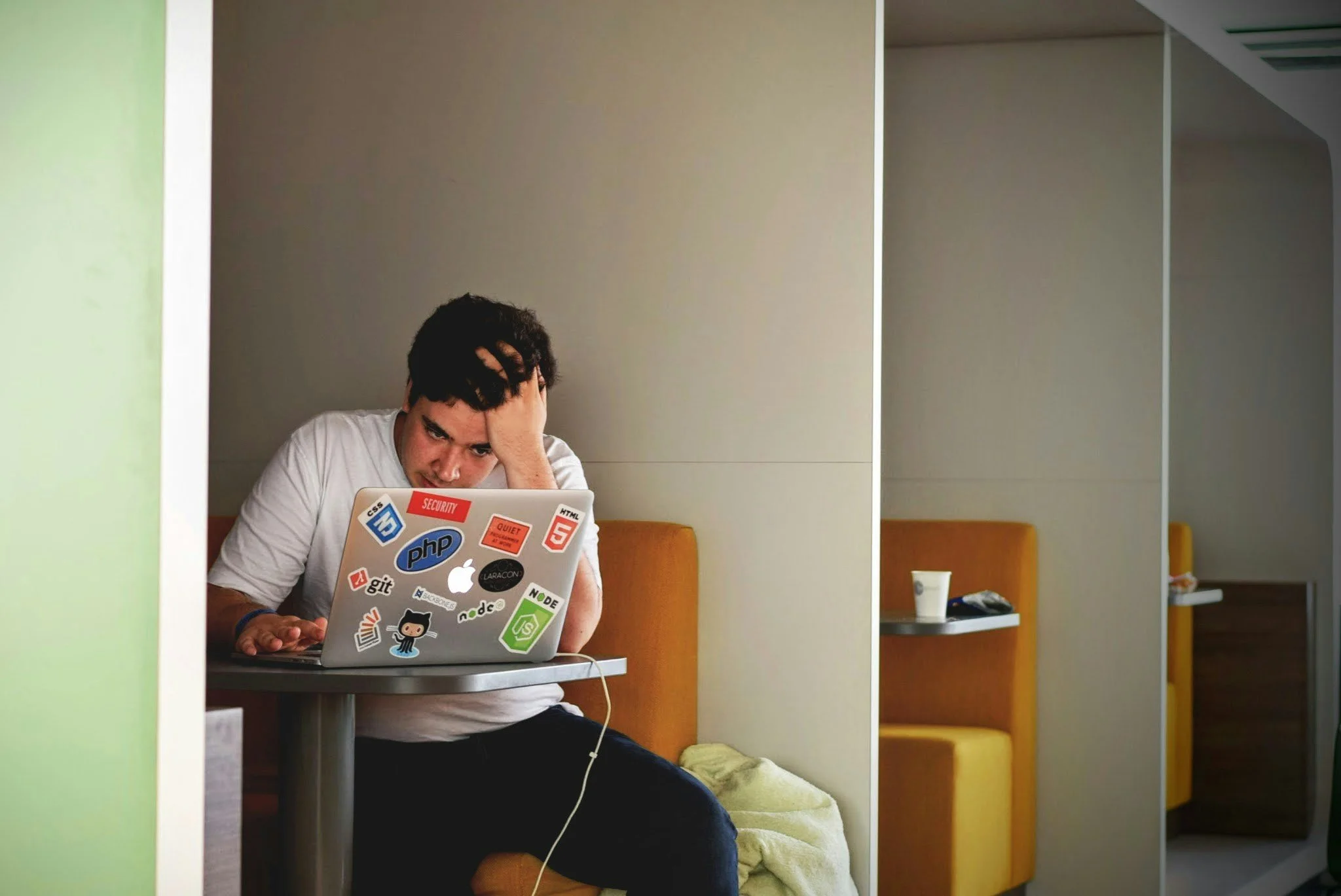
Anxiety is overwhelming enough on its own. But when the anxiety itself becomes the object of fear, the cycle gets harder to exit.
You notice a small physical sensation. Instead of letting the sensation move through, you panic. You start asking whether this is getting worse. You avoid situations where anxiety might show up, and the avoidance slowly builds.
This is sometimes called second-order anxiety, or anxiety about anxiety. Fear of the feeling creates more feeling. Resistance tends to amplify, not reduce, the sensation.
Here's why the cycle forms, and what tends to help.
Why Anxiety Feeds on Itself
Your nervous system is designed to detect threats. When you react to anxiety with alarm, your brain reads the alarm as confirmation: something is wrong. Heart rate climbs. Thoughts spiral. The original sensation intensifies.
The loop runs like this. A physical sensation arrives, a tight chest, racing heart, or restlessness. You react with fear toward the sensation. That fear sends another wave through your body. You feel less in control, which reinforces the fear of anxiety itself.
Over time, anxiety stops being a response to external stressors. Anxiety becomes something you dread in advance, which keeps the loop running even when nothing stressful is happening.
What Tends to Help
Allow the sensation instead of fighting it
Resistance tends to signal danger to your nervous system. When you try to shut anxiety down immediately, your brain reads the urgency as confirmation that a threat is present.
A useful shift: instead of "I need to stop this right now," try "I feel anxious. This is okay. This will pass."
Letting anxiety exist without adding a second layer of alarm reduces its grip over time. Easier said than done, and worth practicing.
Reframe the sensation as discomfort, not danger
Anxiety is uncomfortable. Anxiety is not harmful. Your body is responding to stress, not signaling a real emergency.
The more your brain learns to read anxiety as temporary discomfort rather than threat, the less fuel the cycle has to sustain itself.
A useful internal phrase: "This is uncomfortable, and I'm safe."
Shift from "what if" to "what is"
Anxiety runs on future-focused thinking. Spirals usually begin with worst-case projections, not present-moment facts.
When the spiral starts, try grounding in what is happening right now. What do you see, hear, and feel? What is true in this moment?
Attention to the present interrupts the thought loop before it builds momentum.
Use your breath to signal safety
Shallow breathing tells your nervous system you're under stress. Slowing your exhale signals the opposite.
One option: inhale through your nose for four counts, hold for seven, exhale slowly through your mouth for eight. This is called 4-7-8 breathing. The long exhale activates the parasympathetic nervous system, shifting your body out of the alarm state.
Name what's happening
Labeling an emotion reduces its intensity. Something as simple as "this is anxiety, my nervous system is trying to help" creates a small amount of distance between you and the sensation.
With distance, the thoughts feel less automatic and less consuming.
Stop monitoring yourself
Checking whether the anxiety is still there tends to keep it there. The more attention you give the sensation, the more prominent the sensation becomes.
When you notice yourself asking "am I still anxious?", redirect attention to something concrete: a task, a physical movement, a conversation. Anxiety fades faster when you stop treating it as the primary thing demanding your focus.
When to Consider Therapy
If anxiety is interfering with sleep, work, or relationships, working with a therapist gives you a structured place to understand why the cycle keeps returning and what specifically sustains it for you.
Therapy for anxiety is not about eliminating the sensation entirely. The aim is building a different relationship with it, one where anxiety no longer runs the same kind of interference in your daily life.
If any of this resonates, online anxiety therapy is worth exploring.
About the Author
Taylor Garff, M.Coun., LCPC, CMHC, LPC, CCATP is a licensed therapist with over 10 years of experience helping adults manage anxiety, overwhelm, and identity challenges. He is licensed in Idaho (LCPC #7150), Utah (CMHC #6004), Colorado (LPC #0018672), Connecticut (LPC #8118), and Florida (TPMC #1034). He is certified in HeartMath, Safe and Sound Protocol (SSP), and breathwork facilitation. Taylor is the founder of Inner Heart Therapy, where he provides online therapy across multiple states.
