How to Use Polyvagal Theory to Feel Safer in 5 Easy Steps
Your nervous system decides whether you feel safe or threatened before your conscious mind weighs in. That decision shapes everything: your mood, your energy, your capacity for connection, your ability to think clearly.
Polyvagal theory, developed by Dr. Stephen Porges, explains how this process works. Your autonomic nervous system constantly scans the environment for cues of safety or danger, a process called neuroception. When the system detects threat, your body shifts into protective mode. When the system detects safety, your body relaxes and social engagement becomes accessible.
The key insight: you do not need to think your way into feeling safe. You work with your body to send safety signals your nervous system recognizes. These five steps show the path.
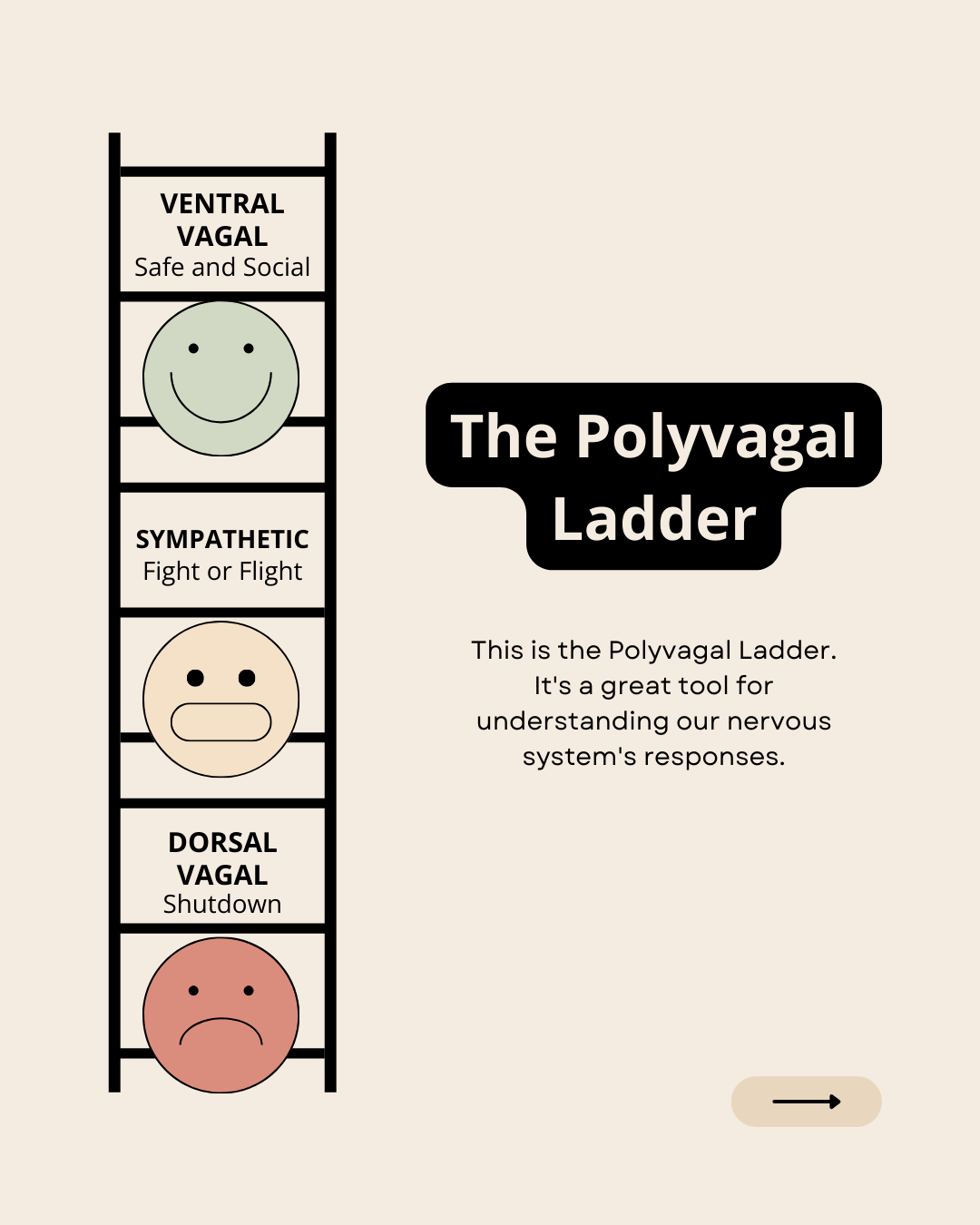
Step 1: Identify Your Current Nervous System State
Before you regulate, you need to know where your system is right now. Polyvagal theory describes three primary states:
Ventral vagal (safe and social): You feel calm, present, and able to engage with others. Breathing is steady. Your body feels relaxed but alert. This is your system's home base.
Sympathetic activation (fight or flight): You feel anxious, restless, or irritable. Your heart rate climbs. Thoughts race. Your body is mobilized for action against a perceived threat.
Dorsal vagal (shutdown): You feel numb, heavy, or disconnected. Everything feels like too much. Your body conserves energy by withdrawing from engagement.
How to check in:
Pause and notice your body. Where do you feel tension, numbness, or ease?
Name the state without judgment: "My system is in fight-or-flight right now" or "I am in shutdown mode."
Track patterns over a few days. You will start noticing which situations, people, or environments push your system toward activation or withdrawal.
Knowing your state is the starting point. Each state responds to different interventions, and matching the tool to the state produces stronger results.
Step 2: Use Breathwork to Activate the Vagus Nerve
Your breath is a direct communication line to your nervous system. Slow, extended exhales activate the vagus nerve, sending a calming signal from body to brain.
The extended exhale technique:
Inhale through your nose for 4 counts
Hold gently for 4 counts
Exhale slowly through your mouth for 6 to 8 counts
Repeat for 2 to 5 minutes
Why this works: The exhale phase activates the parasympathetic branch of your nervous system. Your heart rate slows. Blood pressure decreases. The brain receives a signal: no immediate threat.
If extended breathing feels uncomfortable or increases anxiety, try shorter versions. Inhale for 3, exhale for 5. Sighing and humming also activate the same calming pathways through vagal stimulation without requiring structured breath holds.
Practice during calm moments. Your nervous system builds familiarity with the technique, making the response faster and more accessible when you need support under pressure.
Step 3: Use Gentle, Rhythmic Movement to Reset Your System
When your system is stuck in fight-or-flight or shutdown, movement helps discharge the stored activation.
For fight-or-flight (hyperarousal):
A slow, deliberate walk, especially outdoors where your eyes engage with distance
Gentle rocking or swaying
Light stretching focused on the neck, jaw, and shoulders where tension gathers
Yoga or other slow, intentional movement practices
For shutdown (hypoarousal):
Shaking your hands, arms, and legs to wake up the system
Self-massage: pressing your feet into the ground, rubbing your arms
Playful movement: bouncing, swaying, dancing to a song
Start as small as needed, even wiggling your fingers counts as a signal to your nervous system
The key is rhythmic and predictable. Your nervous system reads regularity as safety. Erratic or intense movement triggers more activation rather than resolving existing activation.
Step 4: Use Co-Regulation Through Safe Connection
Your nervous system was designed to regulate in relationship. Co-regulation, borrowing a sense of calm from another regulated nervous system, is one of the most effective paths to settling your own system.
Ways to access co-regulation:
Spend time with someone who makes you feel genuinely safe and grounded
Physical contact: a hug, holding hands, sitting close to someone you trust
Cuddle or sit with a pet (animals provide effective co-regulation)
Listen to a soothing, familiar voice: a trusted person's voicemail, an audiobook narrator, a podcast host whose tone settles you
If direct social interaction feels overwhelming, passive co-regulation works. Hearing a calm voice, being in the same room as someone regulated, or watching a video of a person speaking softly all send safety cues to your system.
Co-regulation is not a sign of weakness. Human nervous systems are wired for connection. Seeking regulation through relationship is the system functioning as it was designed to function.
Step 5: Engage Your Senses for Grounding
Your sensory system offers a direct route back to the present moment. When your nervous system is in threat mode, the system is oriented toward the future (anticipation) or the past (replay). Sensory input anchors your attention to right now.
Sensory grounding options:
Touch: A weighted blanket across your lap, warm water running over your hands, the texture of fabric or a smooth stone
Smell: Scents that your brain associates with calm, whether lavender, coffee, cedar, or something personal
Sight: Soft lighting, natural environments, or a familiar space arranged for comfort
Sound: Gentle music, nature sounds, white noise, or silence
Taste: Warm tea, dark chocolate, or anything with a distinct flavor that brings your attention to the sensation
Experiment to find which sensory channels your system responds to most. Some people settle fastest through touch. Others respond to sound. The right tool is the one your body recognizes as a safety cue.
Say The Good Thing Out Loud
Something that I attach to each step above is to narrate the good out loud. When a coping skill lands, even ten percent, say so. My shoulders dropped, the breath reached my belly. Spoken words tag an experience more deeply than silently noticing it, which matters because the pleasant moments fade fast while unpleasant ones tend to hang around much longer.
Building a Daily Practice
These five steps work best as a consistent practice rather than an emergency toolkit. Your nervous system builds new patterns through repetition and predictability.
A simple daily framework:
Morning: 2 to 3 minutes of extended exhale breathing before your first screen interaction
Midday: A brief state check-in (What state am I in? What does my body need right now?)
Evening: One grounding activity, a walk, a warm drink, or a few minutes of sensory engagement before bed
Small and daily builds stronger patterns than intense and occasional. Two minutes of breathwork every morning teaches your system more than a 30-minute session once a month.
When Professional Support Deepens the Work
Self-guided polyvagal practices build a meaningful foundation. Therapy adds depth by helping you identify which experiences shaped your nervous system's default settings and by providing the co-regulation of a therapeutic relationship. If you're in Idaho, I offer polyvagal informed therapy in North Idaho.
Approaches that pair well with polyvagal-informed work include nervous system mapping, the Safe and Sound Protocol (SSP), breathwork, and body-based regulation tools calibrated to your specific patterns.
Inner Heart Therapy offers online anxiety therapy across Idaho, Utah, Colorado, Connecticut, Delaware, South Carolina, and Florida.
Frequently Asked Questions
What is polyvagal theory in simple terms?
Polyvagal theory explains how your nervous system automatically scans for safety or danger and shifts your body into one of three states: calm and connected, fight-or-flight, or shutdown. The theory provides a framework for understanding why you feel the way you feel and how to help your body shift toward safety using body-based tools.
How long before I notice results from these steps?
Most people notice a shift within the first week of consistent practice. Breathwork and sensory grounding produce immediate (though temporary) relief within 60 to 90 seconds. Lasting nervous system changes, where your baseline becomes calmer, build over weeks to months of daily practice.
What if breathwork makes my anxiety worse?
Skip the breath hold entirely. Try a simple inhale for 3, exhale for 5 pattern. If structured breathing still feels activating, start with movement or sensory grounding instead. Return to breathwork once your system feels more settled. The goal is always to meet your system where the system is, not force a technique.
Is polyvagal theory backed by science?
Polyvagal theory is supported by extensive research on autonomic nervous system function and vagal regulation. The clinical applications, particularly around co-regulation, breathwork, and the Safe and Sound Protocol, have a growing evidence base for anxiety, trauma recovery, and emotional regulation. Worth knowing: a 2025 paper co-signed by 38 neurophysiology experts challenged the theory's core anatomical claims. The tools in this post are not affected by that debate, but if you've seen those headlines, here's what the polyvagal theory criticism actually says and what still holds up.
Do I need a therapist to use polyvagal theory?
You do not need a therapist to begin practicing these five steps. Self-guided regulation builds a meaningful foundation. Therapy becomes valuable when the nervous system patterns are deeply rooted, when self-guided work has plateaued, or when you want support identifying the experiences that shaped your system's defaults.
Which step should I start with?
Start with Step 1 (identifying your state) and Step 2 (breathwork). These two practices are the most accessible and provide the foundation for the other three steps. Once you feel comfortable with state awareness and breathing, layer in movement, co-regulation, and sensory grounding.
About the Author
Taylor Garff, M.Coun, LCPC, CMHC, LPC, CCATP is a licensed therapist with over 10 years of experience helping adults manage anxiety, overwhelm, and identity challenges. He is certified in HeartMath, Safe and Sound Protocol (SSP), and breathwork facilitation. Taylor is the founder of Inner Heart Therapy, where he provides online therapy across multiple states.
Last reviewed: November 5, 2025 by Taylor Garff, LPC, LCPC, CMHC (Licensed in CO, CT, ID, UT, FL).
